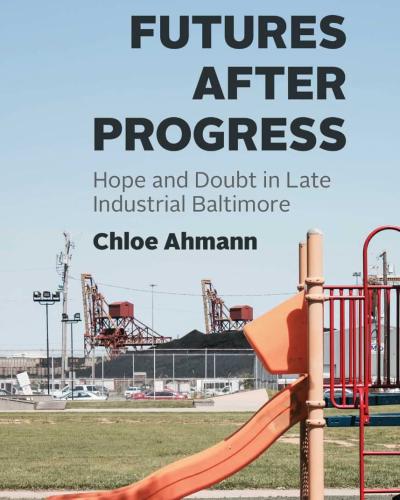
Professor Chloe Ahmann's book, Futures After Progress: Hope and Doubt in Late Industrial Baltimore, received an Honorable Mention for the Gregory Bateson Book Prize.
The Gregory Bateson Book Prize is awarded by the Society for Cultural Anthropology. Named after distinguished anthropologist, semiotician, cyberneticist, and photographer Gregory Bateson, the award reflects the SCA’s mandate to promote theoretically rich, ethnographically grounded research that engages the most current thinking across the arts and sciences. The Gregory Bateson Prize looks to single out work that is interdisciplinary, experimental, and innovative.
The Gregory Bateson Book Prize Jury honored one winner and two honorable mentions.
2025 Gregory Bateson Book Prize Winner:
Lisa Messeri for In the Land of the Unreal: Virtual and Other Realities in Los Angeles (Duke University Press)
Bateson Prize Honorable Mentions:
Chloe Ahmann’s Futures After Progress: Hope and Doubt in Late Industrial Baltimore (University of Chicago Press)
Jean Dennison’s Vital Relations: How the Osage Nation Move Indigenous Nationhood into the Future (University of North Carolina Press)
Ahmann's book also received an Honorable Mention for the 2024 Julian Steward Award, which is awarded by the Anthropology and Environment Society of the American Anthropological Association.
About Futures After Progress:
Futures After Progress offers an intimate ethnography of “hope in the key of doubt” amidst late industry’s ambient remains. Tracing entangled histories of modernist fantasy and structural precarity in South Baltimore, Chloe Ahmann asks what it means to construct a livable future from a profoundly uncertain present. In particular, she engages the subjunctive to consider how competing narratives of place and progress among local residents have produced radically different visions for a better life. Conditioned by centuries of toxic production, racialized anxiety, and dissociative governance, these ways of knowing the future both resist and reproduce the speculative dreams that came before. Each chapter attends to the everyday practices of the possible in a place forever altered, but not wholly foreclosed, by structural violence. The result is a beautifully grounded book that insists late industry’s aftermath is not the same as its ending.
Read more at the Society for Cultural Anthropology announcement.